

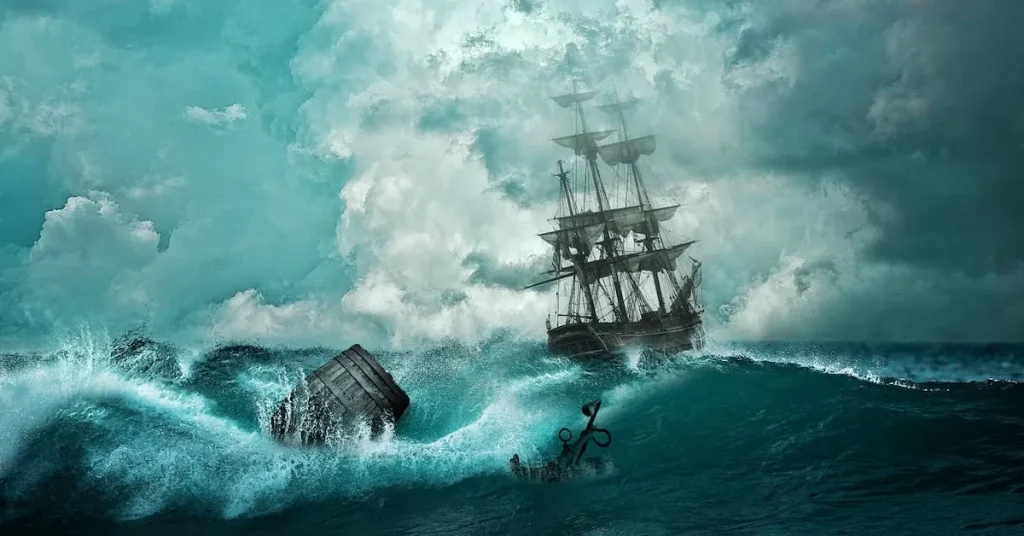

On Florida’s Atlantic coast, there is a stretch of ocean floor that has been attracting treasure hunters for more than 300 years. Beneath the waves lie the remains of Spanish ships that once carried extraordinary wealth from the Americas to Europe. Their cargo included gold, silver, precious stones and valuable trade goods. Some of the treasure was recovered almost immediately after the disaster. Much of it disappeared beneath the Atlantic.
The story began with a hurricane in July 1715, when a Spanish treasure fleet was sailing north along Florida’s coastline on its journey home. The disaster would give Florida’s Treasure Coast its name and create one of the most enduring maritime treasure stories in American history.
But the most fascinating part of the story isn’t simply the lost treasure. It is what happened afterwards: the desperate struggle for survival, the Spanish salvage operation, the arrival of pirates and the generations of treasure hunters who continue to search the wreck sites today.
And remarkably, visitors can explore the story at the very location where survivors and salvagers once established their camp.

A Fleet Carrying the Wealth of an Empire
During the seventeenth and eighteenth centuries, Spain operated an extensive maritime trading system connecting its American colonies with Europe. Ships carried valuable cargoes from ports in the Caribbean and the Americas, transporting the wealth of the Spanish Empire across the Atlantic. The fleets were vulnerable to storms, pirates and the dangers of navigating unfamiliar coastal waters.
The 1715 fleet was returning from Havana, Cuba, carrying a valuable cargo of silver, gold and other goods. Its voyage was already running late, and the ships were traveling along Florida’s Atlantic coastline when disaster struck. On July 31, 1715, a powerful hurricane hit the fleet. The consequences were devastating.
Ships were driven onto reefs and shallow coastal waters, breaking apart along the coastline between present-day Sebastian Inlet and areas farther south. Historical accounts differ over the exact number of vessels lost, with Florida’s historical marker referring to eleven or possibly twelve ships.
The disaster killed approximately a thousand people, although around 1,500 survivors managed to reach the Florida shore. The ocean had swallowed an extraordinary quantity of treasure.
A Desperate Struggle to Survive
For the people who survived the hurricane, reaching land was only the beginning of their ordeal. They found themselves on a relatively isolated coastline with limited food, shelter and fresh water.
The Spanish authorities organized assistance from St. Augustine, sending supplies and personnel to help the survivors. A temporary settlement developed near the location of the flagship’s wreck. This became known as the Survivors’ and Salvagers’ Camp.
The camp was not simply a place where people waited to be rescued. It became the center of a major salvage operation. Spanish authorities wanted to recover as much of the lost cargo as possible before it could be lost permanently or taken by others.
Divers and salvagers began working on the wrecks, attempting to retrieve coins, precious metals and other valuable objects from the seabed. It was a difficult undertaking involving primitive equipment, dangerous conditions and the constant threat of further storms.
The Pirate Who Stole the Recovered Treasure
One of the most remarkable episodes in the story occurred after the Spanish salvage operation was already underway. The English pirate Henry Jennings arrived with armed men and attacked the Spanish salvagers. According to the Florida historical marker, Jennings drove away the guards and seized a substantial quantity of recovered coins, which he transported to Port Royal in Jamaica.
It is an extraordinary episode because the treasure was no longer simply lost at sea. Some of it had already been recovered, counted and brought ashore, only to be stolen in another act of maritime violence.
The incident also illustrates the dangerous world of Caribbean piracy during the early eighteenth century. The Spanish had to contend not only with the hurricane and the ocean but also with rival powers and pirates interested in the wealth of their empire.
The Treasure Hunters Never Really Left
Spanish salvage operations continued for years after the disaster. Although enormous quantities of treasure were recovered, not everything could be located. The wreck sites became scattered underwater archaeological landscapes containing evidence of the original fleet and its cargo.
Over the centuries, coins, jewelry and other objects continued to attract attention. Modern treasure hunting developed into an organized activity, with specialist divers and salvage companies searching the wreck sites using increasingly sophisticated equipment.
The discovery of the wreck of the Spanish vessel Nuestra Señora de Atocha in the Florida Keys in 1985, although unrelated to the 1715 fleet, helped renew worldwide interest in Florida’s shipwreck treasures over a century later. The Treasure Coast became particularly associated with the 1715 fleet and the continuing recovery of its lost cargo.
Today, archaeological discoveries help researchers understand not only the treasure itself but also the people, technology and trading networks of the Spanish colonial world.
It is important to remember that historic wreck sites are protected by archaeological and legal requirements. Visitors should not assume that artifacts can be collected or that every wreck site is open for recreational diving.
Discover the Story at McLarty Treasure Museum
One of the best places to understand the 1715 disaster is the McLarty Treasure Museum, located on North Hutchinson Island near Sebastian Inlet. The museum occupies the historic location associated with the Survivors’ and Salvagers’ Camp, which makes it particularly interesting.
Rather than simply displaying objects recovered from a shipwreck, the museum tells the story of what happened on the shoreline after the hurricane. Visitors can discover exhibits covering the fleet, the storm, the survivors and the Spanish salvage operations. Recovered coins and other artifacts help illustrate the extraordinary wealth carried by the ships.
The museum also explains the archaeological importance of the wreck sites and the continuing fascination with Florida’s maritime treasures. Its position near Sebastian Inlet State Park makes it an excellent addition to a coastal excursion. Visitors can also explore the museum before enjoying the surrounding beaches, waterways and natural scenery, just make sure to check the Florida State Parks website for current admission arrangements and opening information.
The Urca de Lima and Florida’s Maritime Archaeology
Another fascinating part of the 1715 story is the wreck of the Spanish vessel Urca de Lima. Unlike many of the other ships, the Urca de Lima became an important support vessel for the survivors and salvage operations after the disaster. The wreck is now part of Florida’s underwater archaeological heritage and is protected as a historic shipwreck site.
It is also associated with Florida’s Underwater Archaeological Preserve program. For divers, the wreck provides an opportunity to experience a genuine piece of Spanish colonial maritime history. However, this is not simply a recreational diving attraction. Its historical and archaeological importance makes preservation essential.
The Florida Museum of Natural History provides further information about the vessel and the wider history of Spanish treasure fleets.
More Than Three Centuries of Treasure Hunting
The story of the 1715 Spanish Treasure Fleet has survived because it combines extraordinary wealth, human tragedy, piracy, archaeology and the continuing possibility of discovery. But perhaps its most interesting feature is the way the disaster transformed an otherwise relatively quiet stretch of Florida coastline into a place of international historical significance.
The ships may have disappeared beneath the waves, but their story remains visible in museums, archaeological discoveries and the landscape itself. Stand on the shoreline near Sebastian Inlet and it is difficult not to imagine the scene more than 300 years ago: survivors struggling towards land, salvagers establishing their camp and Spanish officials desperately trying to recover the wealth of an empire. That is the real treasure of Florida’s Treasure Coast!


